|
| courtesy: livetalksla.or |
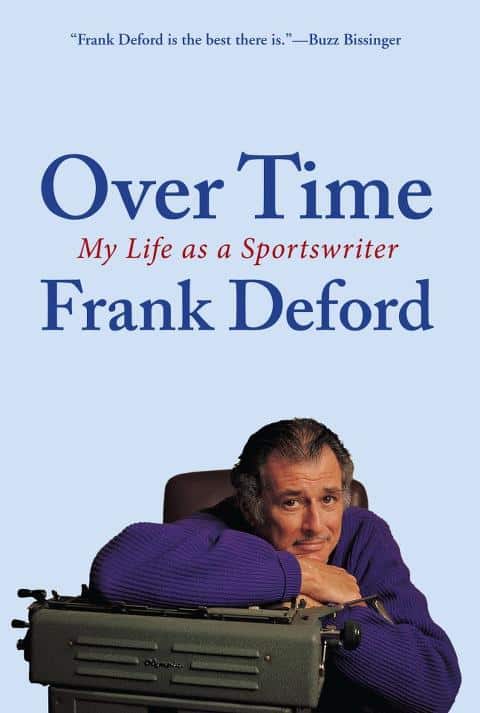
Frank Deford talks of his work Over
Time not as a memoir but a we-moir, a collation of transient
connections with figures more famous than himself. When asked to
write a piece for alma mater Sports Illustrated about his
early days at the United States' foremost sports magazine, he
initially resisted; but as it became obvious there was a desire for a
Mad Men style homage to the golden age of US magazines, no-one
was in a better position to detail those salad days of the sixties.
Were you to boil down Deford's style to
a single adjective, it would be wry. He is observant yet economical,
distilling major events and people into their vital alchemy and
transmitting what he absorbs with a pleasant mix of good humour and
gravitas. He has used the same affable style for fifty years,
through books, editorials and myriad essays; the result is
four-hundred-odd pages of brilliant simple statements. In fact,
Deford writes with vision and simplicity that makes readers often
think “Why didn't I see it that way before?”
This geniality is only magnfied by an
attitude of supreme moderation. Deford is a sporting centreist –
as he proves
with his weekly NPR commentaries – well aware of the unique
position sport occupies in our cultural landscape. At a recent
speech at the Seattle Public Library, he suggested both the import
and triviality of sport by announcing the only two unnecessary
cultural phenomena developed individually by every people have been
sport and religion.
Acutely aware of his position as an
observer rather than newsmaker, he presents his life journey quite
superficially and bases his experiences around those in public life
who were attracting the same attention. Where he writes about
personal matters, it is almost entirely in regard to his artisanship,
or concerning the athletes were the root source of his material and
observations. A perfect example comes from one of the work's final
chapters where he talks with shark Jimmy the Greek about their shared
loss – children lost to Cystic Fibrosis.
This isn't your typical me-me-me book,
detailing “my struggle against the odds” or a list of
accomplishments made more impressive when taken out of context.
Deford freely admits to benefiting from luck and the era in which he
got his start. His writing is about his profession, rather than
himself and as such you find yourself knowing less of the man than
you would choose; no doubt Deford prefers this way. He revels in
what he has seen throughout his career, being able to witness the
triumph and despair that's inherent at any sport; at the same time
however the career is obviously only part of the man.
However, because his scope spans five
decades, he really does no more than touch upon so many of the topics
that could conceivably sell Over Time: these are anecdotes of
his time observing sport, rather than his opinions. The stories are
personal and not hearsay; a particular example being when he caught a
train with a young Muhammad Ali and found him searching for spiritual
and emotional understanding, exploring that which would make him
controversial. In this manner, his writing on Arthur Ashe is sad but
upbeat and the reader absorbs Deford's patent respect for the great
tennis player.
As a text for aspiring sportswriters it
has no definite teaching points, or at least very few. Deford's lack
of personal conceit contributes to this somewhat; his belief is that
writing is something you can or can't do, something rarely learned
well. This seems partially a cover for such a humble man about whom
his craft agrees that he is the patrician.
While there are few absolute
commandments, the aspiring blogosphere would do well to heed his
obvious breadth of vision. The value of a broad intake of news and
views is tacitly suggested, as being well-rounded provides writers
with the ability to place sport and the context from which stories
emerge into a more global spectrum.
It's a wonderful piece of writing. But
from Frank Deford, would you expect anything else?
Footballs.
Suggested other reviews: