Monday, August 13, 2012

Review: Instruments of Darkness - Gary Russell

Gary Russell made me think!  No, really, he did a good thing!  279 pages weren't wasted!  It's a miracle!

Courtesy: doctorwhoreviews.co.uk
During his time writing Past Doctor Adventures, Russell made it a personal crusade to redeem the then-pilloried Sixth incarnation of the Time Lord, fleshing out the lurid continuity of the Colin Baker era.  First came Mel's official introductory story, Business Unusual - which I enjoyed - and eventually a real regeneration for Doc 6 in the form of the immortal Spiral Scratch.

It's campaigns like these that, despite the best of intentions, have earned Russell his reputation as a purveyor of the highest order of fanwank.

That said, however, despite myriad failings, Instruments of Darkness is a reasonable sequel to Business Unusual.

Irritations include a marginalised and relatively-poorly-characterised Doctor, reliance on continuity (although it's much better than some of the author's previous work), stylistic inconsistencies, dialogue peeled straight from the Star Wars prequels and Russell indulging his  Bond fetish.  Naming a pair of female assassins Ms de Menour and Ms (Mal) Feasance?  Inserting a piece about the Doctor introducing Fleming to the ornithologist on whom Bond was based?  The cult-series mix is simply too much for an admittedly-pulpy premise to bear.

But in spite of these elements, Russell deftly portrays a series of interconnected characters whose reliance upon each other is notable.  Throughout the text, couplets emerge where each member is completely dependent on the other - for existence, validation, love.  Even the Doctor is not immune as he encounters the companion that wasn't, Evelyn Smythe; and in fact only Mel appears immune.

This symbiosis is woven unobtrusively throughout and only it hits the reader with real force when it becomes apparent at the novel's conclusion.  It's sweetly juxtaposed with the climactic fireworks brought about by some old-school Doctor trickery reminiscent of Pyramids of Mars.

Tennis balls.

Discontinuity Guide's review of Instruments of Darkness

Saturday, August 11, 2012

An Omnibus of Horse Racing

Throughout my life, the sport of kings has been relatively disinteresting to me. Despite growing up on a full diet of sport obsession, for some reason horse racing never took my fancy. My perception of it has been skeptical, fueled by one question: Is there a point to it beyond being a vehicle for gambling? Can you have a passion for it without needing to risk your hard earned, or being loaded to the hilt and able to own one of the creatures?

Despite being proud of the fact I had managed to avoid watching the last eight or nine Melbourne Cups, I fell into the Black Caviar phenomenon upon its closure at Royal Ascot. I became desperate to understand what attracts people to the sport, why it is so ingrained in our Australian culture, why was Vo Rogue a cult hero, and to finally understand the theory behind weight for age. I present to you five titles that have taken me on this journey.

  1. A Year on the Punt – John Ellicott

My journey got off to a poor start, when I managed to learn less than nothing and in fact digress in my opinion of the sport thanks to this title. A journalist and petty gambler takes his long service leave and ventures far and wide across Australia to visit regional racing carnivals, learn more of the history of racing, and pick up some tips for being an effective picker of winners.

Maybe that is what Ellicott planned to do however what he presented pretty much summed up my long held reasons for prejudice against the sport. Every club he visited was struggling to survive save for the turnover of gambling through the TAB (although they do not like having to conform to the rules of the TAB). In addition the greatest stories nine times out of ten were the debaucherous antics of racegoers (and club committeemen) no mention of any equine heroes. Into the bargain the author annoys the heck out of you as a reader trying to behave as a stereotypical 'Aussie' and clearly even his own writing indicates he was more often than not annoying those at the races as well. No Balls.

  1. True Grit – Les Carlyon

After the terrible start I went into my further reading without much hope, but I was reinvigorated and identified that what Gideon Haigh is for Australian Cricket, Les Carlyon is to Australian racing. If he has not touched it, do not either. Out of all the books read this was the one that really answered my questions and allowed me to more easily comprehend the passion one could have for horse racing.

Carlyon is a long time Melbourne journalist and True Grit is a compilation of some of his best work on his great love. Given its nature the book does not seek to systematically educate you however you pick up enough along the way. You learn of the champions (Vo Rogue included) and the lesser lights in sport, coming away with a rounded view that yes I may grow to like it. If you can only read one book on horse racing, this is it – Basketballs.

  1. The Track – Mike Hayes

Transforming a television series into a book is difficult, you go from having had images and body language plus words into text and the track although full of information suffers for hit. This was ABC televisions program on the history of Australian racing, presented by topic rather than chronologically. There are many interview subjects (Les Carlyon included) that give their opinions on all subjects however it can feel repetitive with the same incidents often being discussed under multiple topics.

You do learn a lot about the history, what drew and still draws people in, therefore functionally it has served its purpose – Tennis Balls.

  1. The Master – Les Carlyon

What makes a book about someone’s life a portrait and not a biography? Broad brush strokes with an eye for detail where required, and Les Carlyon succeeds with this portrait of Bart Cummings. Despite knowing little of horse racing one fact you do know as an Australian is that Bart Cummings has trained the most Melbourne Cup winners, by a long way and is a legend in racing circles.

The book is not only a great read but a beautiful presentation of horse racing images throughout the years and could serve well on a coffee table as well as in a library. Carlyon perfects just the amount of information to give about Cummings as you journey through his life, learning the great successes and the tragedies (which there are less). You leave with no deified image of Cummings except that he is a good horseman, his people skills appearing to leave something to be desired, and that the Australian racing industry is very much built on individuals like him. Basketballs.

  1. They're Racing – Gary Hutchinson (Editor); Foreward by Les Carlyon

None of the books read have the sheer volume of information brought by this volume. Chronologically from the first white settlement up until the end of the 20th century every key moment, person, race and of course horse is profiled. The book is set up for reference and is easy reading dipping in and out. Further there is much enjoyment of the hundred's of images provided. Because you are not reading the same work consistently it is difficult to draw a consistent line through the sport in this presentation, one piece may not relate to another and repetition is again in this work as in The Track. But for the number of facts per hour reading this is the choice. Tennis Balls.


Cover Images Available thanks to abc.net.au and boomerangbooks.com.au

Monday, August 6, 2012

Review: Sixty years on the back foot - Clyde Walcott

The Caribbean has produced several of the greatest batsmen of all time. However, many of these players seem to rail against faceless figures of authority. Currently, talisman Chris Gayle swats boundaries at whim – more often for lucrative T20 sides than for the West Indies. The chain which leads back through the likes of Brian Lara and Sir Vivian Richards – who was rather partisanly profiled in the acclaimed documentary Fire in Babylon – to George Headley.

Sixty years on the back foot
Courtesy: amazon.com
The second (or third, or fourth depending on how you look at it) of these superstars was Sir Clyde Walcott, a forerunner of devastating West Indian batsmanry and later president of the International Cricket Council. His autobiography, Sixty years on the back foot, was published at the conclusion of his ICC tenure in 1997.

His memoir is lightweight – entire tours are glossed over, especially those in which the West Indies struggled – and Walcott writes with the style of a man who finishes lengthy believable anecdotes with “Can you believe it?”. However, the parallels between West Indian cricket in 1952 and in 2012 are too plain to ignore.

Along with Sir Everton Weeks and Sir Frank Worrell, Walcott was one of the famed “Three Ws”, three Bajan players raised within a mile of each other and who helped West Indian cricket attain relevance in the 1950s. The significance of the three friends and their relationship is underscored throughout Walcott's writings as he attempts to characterise Caribbean cricket through their free-hitting exploits.

He does this for a simple reason: Walcott unquestionably thought that West Indian cricket, when played hard but for fun, is superior to any other. (Ed: he may be right) Time and again, his tacit disdain the orthodoxy inherent in 1950s English cricket is obvious; simultaneously he rejoices in the laid-back joie de vivre that formerly typified West Indian cricket.

Although Fire in Babylon incorrectly suggested that calypso cricket was provided only a team of loveable freewheelers (ie. losers), you can't escape the feeling while Walcott revelled in victories, he wouldn't countenance sacrificing style to achieve more success. His transition from money-chasing maverick pro to WICB ambassador adds another intriguing dynamic. However, like most politicians, his autobiography is an exercise in using many words to avoid saying much at all.

Although Walcott's memoir hearkens to different times, where pacemen were named Esmond Kentish and Foffie Edwards, there are still familiar cricket themes. Race relations, though downplayed, provided undercurrents of discontent. The same could be said for matters of money, as cricketers were still strictly classified as “professional” or “amateur”. That Worrell, Weekes and Walcott were forced to choose between making a living playing English league cricket rather than representing the West Indies provides a fifty-year prophecy of the WICB's current struggles with player free-agency.

The same issues have plagued West Indian cricket now for sixty years. The islands' success from 1975 to 1995 and more widespread cricketing professionalism only masked the difficulties of West Indian players and administrators. That the situation is unchanged over so long, coupled with difficult economic factors leaves the reader feeling that this situation is now intractable in West Indian cricket and the game is so much the poorer.

However disappointing the state of West Indian cricket, it's perhaps more disappointing that such an eminent figure in the game stuck true to his political, rather than returning to his maverick roots and challenging major failings in Caribbean cricket politics. Marbles.

Tuesday, July 31, 2012

Review: In the Hornets' Nest - Joe Drape

The sheer sweaty bodyweight of beat writers attached to American sports teams makes books which chronicle one team's journey over an entire season relatively commonplace. It's not an original concept, and basketball teams lend themselves to these diaries more than most. The Jordan Rules, A Season on the Brink (by John Feinstein) and The Breaks of the Game are required reading for hoops fans.

In 1988-89, two season chronicles emerged simultaneously about compelling storylines at opposite ends of the NBA. The Franchise examined Jack McCloskey, the General Manager of the Championship-winning Detroit Pistons; the other, by Atlanta Journal-Constitution journalist Joe Drape, detailed the Charlotte Hornets' first NBA season. The result is In the Hornets' Nest.

Expansion is a gripping hook. There aren't many stories written about lousy teams, especially smaller-market ones. How often do you get a dynamic and in-depth record of building a franchise from the ground up?  In the Hornets' Nest should be a work of historical significance simply by existing; unfortunately it becomes a collection of beat-writer standards which don't do full justice to a fascinating period in the NBA's history.

New teams inherently offer plenty of angles, partly because the cast of characters is hungry and disparate, but also because – by design – they stink. Each member of an expansion team, administrator or player, has one goal: to do well enough to make money. When twenty characters all attempting to secure their individual futures are combined, an intriguing and rare set of pressures evolve; cataloguing individual and collective responses makes for fascinating reading.

This human element sells sports books.  Unfortunately, apart from boardroom machinations early and late, the personal element rarely comes through in Drape's book; this makes it feel insubstantial and perfunctory.  Watching an expansion team for the results is nonsensical; what matters are the foundations put in place for future success.  Perhaps because Charlotte's player base was so obviously transient it became difficult to see any individual improvement coming from any of their established players.

Photo courtesy: amazon.com
When a nascent organisation develops, a maturity story can be attached both to individual elements and the structure as a whole – there's always interest (and a market) for coming of age tales. This aspect is also disappointingly downplayed; the only figure to be treated to three full dimensions is George Shinn, the man least acquainted with pro basketball and also the man with the most to learn.

When executed poorly, attempts at documenting eight months of human interaction can become a series of individual portraits rather than a slow crystallisation of overall character. Unfortunately, rather than opting to "grow" the Hornets' staff over the course of the season, Drape inserted WYSIWYG potted character studies which are rarely referred to later. Despite their fascinating roles, GM Carl Scheer and coach Dick Harter are treated to the same three page allottment as backup point guard Muggsy Bogues.

While lightweight, the book rams home a few crucial differences between The Leagues of then and now. The typical late-80s pursuit of size – any size – is highlighted, resulting in career third-stringer Stuart Gray being written about more than even his Mum thinks he deserves. Also, there is an obvious lack of process and method about both coaching and personnel decisions. Harter's coaching philosophy often suggested that improvement couldn't come from within but from outside; oddly, but understandably, Drape's writing reflects the same tenor when it comes to individual and collective maturity.

There are frequent gaps. Three quarters of the book has passed before Drape mentions who the team's starting point guard was (it was the immortal Michael Holton) and what should have been the most interesting sections of all – the 1988 expansion draft and the 1988 NBA draft – barely rate a mention.

There's a beat-writer's style to Drape's writing. He is even-handed so much so that it could be mistaken for a lack of joy; the same could be said of the players and administrators: the only people to see the season as an experience rather than something to be endured before they could draft again. It's easy fodder for basketball fans.  Tennis Balls.

Wednesday, July 18, 2012

Review: Elisabeth Sladen - An autobiography

When Elisabeth Sladen passed away in April 2011, I was shocked and upset than at the death of any other of my childhood fiction stalwarts.  She consistent, intriguing and still on TV, but her death shook me up more so than even that of her co-star (and my then-hero) Jon Pertwee in 1996, despite that occurring in the midst of my teen-angsty-crying-at-the-drop-of-a-hat phase.

Her most notable role by far was as Doctor Who's best ever companion, Sarah Jane Smith, a role she played, on-and-off for nearly forty years. Her autobiography, released posthumously, is an interesting work which speaks volumes - in hushed tones - about the woman who would have preferred to be known as Elisabeth Miller.  Of course due to the vagaries of Equity, the UK actor's guild, that wasn't ever a possibility but contributes to the defining theme of her memoir, of someone utterly at home in family settings.

Thursday, July 12, 2012

Review: The Twelve Caesars - Michael Grant

www.eveningstarbooks.info
Michael Grant was a noted twentieth century historian who focused predominantly upon the early Roman empire.  He published several well-regarded works on that culture in that period, including perhaps his seminal piece The Twelve Caesars.

This narrative, which leans heavily upon the usual suspects (Suetonius, Pliny and Tacitus) is a conversational textbook - a popular version of a book of learning, much like I, Claudius - very much in vogue throughout the latter half of last century.  It delivers a potted biography of Julius Caesar and his eleven direct replacements - from Augustus to Domitian.

As a work, it delivers simply what it suggests on the packet: small bios, pieced together from influential - but hardly neutral - sources.  Grant time and again points out that Suetonius tended to highlight the sexual depravities of his subjects, while Tactitus' words showed contempt for each of the three Caesars who rose to their position via civil war (Galba, Otho and Vitellius).  

He delivers simple, effective portraits of highly complex men - figures simplified by period literature through rumour and suggestions being made out as fact.  He is even-handed and resists editorialising, except for during the last chapter where he tries unsuccessfully to "sum up" and only manages to confuse himself and his readers.

Unfortunately, there really is very little else to say.  Grant writes as an academic, with economy of emotion, as if just putting words down on paper for future generations.  If you're interested in the period or a history buff, then it's certainly worth a look - otherwise the source material may prove a little dry.  Tennis balls.

Monday, July 2, 2012

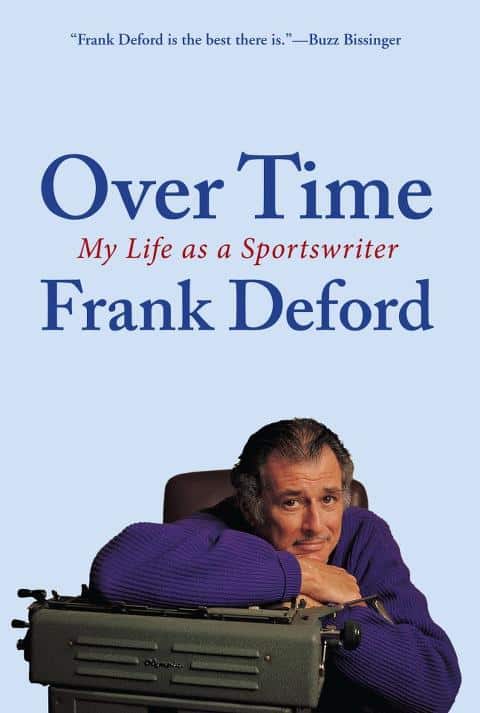
Review: Over Time - Frank Deford

courtesy: livetalksla.or
Frank Deford talks of his work Over Time not as a memoir but a we-moir, a collation of transient connections with figures more famous than himself. When asked to write a piece for alma mater Sports Illustrated about his early days at the United States' foremost sports magazine, he initially resisted; but as it became obvious there was a desire for a Mad Men style homage to the golden age of US magazines, no-one was in a better position to detail those salad days of the sixties.

Were you to boil down Deford's style to a single adjective, it would be wry. He is observant yet economical, distilling major events and people into their vital alchemy and transmitting what he absorbs with a pleasant mix of good humour and gravitas. He has used the same affable style for fifty years, through books, editorials and myriad essays; the result is four-hundred-odd pages of brilliant simple statements. In fact, Deford writes with vision and simplicity that makes readers often think “Why didn't I see it that way before?”

This geniality is only magnfied by an attitude of supreme moderation. Deford is a sporting centreist – as he proves with his weekly NPR commentaries – well aware of the unique position sport occupies in our cultural landscape. At a recent speech at the Seattle Public Library, he suggested both the import and triviality of sport by announcing the only two unnecessary cultural phenomena developed individually by every people have been sport and religion.

Acutely aware of his position as an observer rather than newsmaker, he presents his life journey quite superficially and bases his experiences around those in public life who were attracting the same attention. Where he writes about personal matters, it is almost entirely in regard to his artisanship, or concerning the athletes were the root source of his material and observations. A perfect example comes from one of the work's final chapters where he talks with shark Jimmy the Greek about their shared loss – children lost to Cystic Fibrosis.

This isn't your typical me-me-me book, detailing “my struggle against the odds” or a list of accomplishments made more impressive when taken out of context. Deford freely admits to benefiting from luck and the era in which he got his start. His writing is about his profession, rather than himself and as such you find yourself knowing less of the man than you would choose; no doubt Deford prefers this way. He revels in what he has seen throughout his career, being able to witness the triumph and despair that's inherent at any sport; at the same time however the career is obviously only part of the man.

However, because his scope spans five decades, he really does no more than touch upon so many of the topics that could conceivably sell Over Time: these are anecdotes of his time observing sport, rather than his opinions. The stories are personal and not hearsay; a particular example being when he caught a train with a young Muhammad Ali and found him searching for spiritual and emotional understanding, exploring that which would make him controversial. In this manner, his writing on Arthur Ashe is sad but upbeat and the reader absorbs Deford's patent respect for the great tennis player.

As a text for aspiring sportswriters it has no definite teaching points, or at least very few. Deford's lack of personal conceit contributes to this somewhat; his belief is that writing is something you can or can't do, something rarely learned well. This seems partially a cover for such a humble man about whom his craft agrees that he is the patrician.

While there are few absolute commandments, the aspiring blogosphere would do well to heed his obvious breadth of vision. The value of a broad intake of news and views is tacitly suggested, as being well-rounded provides writers with the ability to place sport and the context from which stories emerge into a more global spectrum.

It's a wonderful piece of writing. But from Frank Deford, would you expect anything else?

Footballs.

Suggested other reviews: