Showing posts with label Marbles. Show all posts

Saturday, April 21, 2012

Review: And God Created Cricket – Simon Hughes

Former veteran county cricketer now cricket journalist Simon Hughes posits this work as being something of an antithesis to the efforts provided by most cricketing historians. Hughes even goes as far to mention that those works developed by ex-Prime Ministers are too serious. 'And God Created Cricket' is a light hearted romp through centuries of cricket (not to mention debauchery, skulduggery, and downright bad manners).

Hughes has researched others works to provide the flow of events from which he latches onto the more obscure notes of players and matches and embellishes the stories to their full extent. One must credit Hughes for sticking to the historical script well, providing those with less desire for details, a work of ease to get a picture of the history of cricket. But there are flaws.

Firstly, as a tabloid journalist one should not be surprised, Hughes seems incapable of allowing a chapter to pass without finding need to mention or compare cricket to Premiership Football. Really if you had never heard of Hughes the cricketer (and likely given his mediocre career you would not have) you would think that he is a Football journalist trying his hand at something new. Some of the references are just a waste of words. Cricket has a history longer and with far greater depth than any football code, to feel it necessary to attract readership this way is missing the point.

Secondly, there are a number of errors throughout the book, the sort of errors that should never get through good proof reading and editing, but they did. These are not errors of judgement in interpreting history but errors of name. The 1930's Australian batsman was Vic Richardson, not Viv; and the bowler Fleetwood-Smith's Christian name was not Laurie, but Leslie and in fact he was better known as 'Chuck'. Simple things that with some care would have been avoided and may have helped the more educated readership enjoy the book more.

Fair is fair, as a cricketing purist I was unlikely to rate this book above Tennis Balls when I seek so much from cricketing literature, but it does not even make this.  Marbles.

Image thanks to telegraph.co.uk

Monday, April 16, 2012

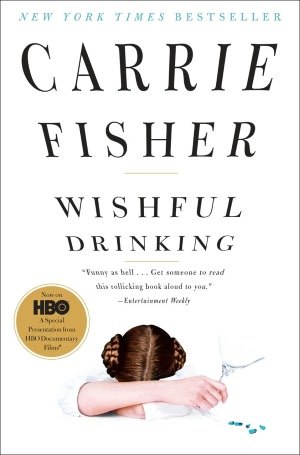
Review: Wishful Drinking - Carrie Fisher

My Mum and Dad were two thirds of the Brad, Jen and Angelina of the '50s.  I love them both despite their flaws.  I did Star Wars.  I married, then dated Paul Simon.  A lot of his (depressing) lyrics are about me.  I have a sense of humour, which is a really good thing.  I was addicted to a whole bunch of drugs and alcohol.  I wrote a novel about it, and my famously dysfunctional family.  A gay friend of mine once died in my bed which gave me PTSD.  My second husband left me for another man, which messed with me even more.  Through all this, I was bipolar, but didn't know it.  When I did, I received electroshock therapy, meaning I can't remember much.  I'm now under treatment and living a more centred, normal life than ever before.

This may as well be Carrie Fisher's book Wishful Drinking, a text adaptation of her successful one-woman stage show.  Really, without much exaggeration, the paragraph above could well represent the entire lightweight 150+ pages.  It's patently a cash-in from the stage show, which was was designed to be a humorous recollection of what led her from famous parents, through Star Wars to Simon, addiction and commitment to various asylums.  Unfortunately this sight-gag-reliant, disjointed and vague approach is acceptable (even desirable) in a spoken word performance, it falls flat as a text.

Image courtesy: barnesandnoble.com
The other reason for this eclectic authorship is a result of Fisher undergoing electroshock therapy for mental illness.  This means she simply doesn't remember much of her life, as the treatment rendered whole chunks of her past are a virtual nonevent.  Being unable to recall much of one's life has the capacity to make a memoir either oddly ethereal or painfully shallow.  Fortunately, Fisher stays mainly with the former and the book accurately represents what she remembers of her life - a series of unconnected events with their nascence stemming from a naive showbiz upbringing, early fame and drugs. 

She gets more serious - but not much, given her stated aim of finding humour in the blackness - when writing of her issues with mental health.  The book ends with a moving one-page tribute to those similarly afflicted, pleading for their everyday battle needs to be respected rather than shunned.  Fittingly and redeemingly, it is the most coherent and lucid page of the entire book.  The narrative style means Fisher's constant struggle with mental illness is danced around, but is the gravitas keeping the book from being not so much light as vaporous.

There is every chance my answer to the archetypal profile question "Who would you most like to have dinner with?" would include Carrie Fisher.  This would be for reasons of then and now.  (The second clip actually boasts many/most of the book's best gags.)  While the botox-free 1982 version would be welcome for re-living my childhood and teen years, the 2012 edition would provide a completely different perspective on almost every conversation.  As much as my teen self hates my 2012 version for writing it, this year's Carrie Fisher would take a seat at my table.  However, this still can't make me recommend her book too highly - marbles - it loses something in translation.  See the show instead.

Tuesday, March 27, 2012

Review: Fragile Things - Neil Gaiman

I'd heard so much about Neil Gaiman.

He's probably the most followed auteur author on Twitter, he wrote a quality episode of my favourite TV programme (Doctor Who - The Doctor's Wife), I loved the movie Stardust and he's become a sort-of geek Elvis.  Inspired, I reserved a copy of a short story collection from my local library, my first Gaiman.

I hope I chose poorly.

Fragile Things is a collection of short stories and poetry that Gaiman was commissioned to write for various collations.  It begins with a twenty-odd page exploration into the roots of each tale, during which he writes about a time where he began to collaborate with master of the genre Harlan Ellison.  He says that Ellison had to finish one of his own works, and told Gaiman to begin work on their short story and he'd catch up.  When he returned, he told Gaiman "No, not doing it - it reads like Neil Gaiman".  This could perhaps sum up the book better than any of my observations: Gaiman has his own recognisable style which he pairs with a varying tone from story to story.

Which is fine, of course, expected even - except when the stories aren't grabbing the reader.  The title, Fragile Things, is perhaps the most enjoyable aspect of the work, for it perfectly describes Gaiman's writing.  He uses each word precisely, delicately and lightly, giving the reader the feeling that should they close the book too quickly, the words of the text will dislodge and flutter into disorder.  He writes like one assembles a jigsaw - there is no alternative but to be precise.

Courtesy: Jar of Juice
He is an artisan, respectful of the written word and it's propensity misuse and so writes with paramount agility.  Unfortunately for my preferences though, his deftness with sentence construction is paired with a minimalist approach to storyline; this collection comprises mainly beautifully constructed scenes which rarely tell the end of the tale.

The stories within are immaculate games of "What If...", leading to a number of unusual situations, but often lack resolution.  In many ways, this book is like a lighter collection of Coen Brothers short films - stuff happens and then the movie ends.  Given my past reviews, it should come as no surprise  that resolution forms a key part of my literary enjoyment.  Gaiman, like the Coens, aren't strong on this and prefer to present interesting scenes that leave the reader where the artist started - with a "What about..."

In Volume One of his prison diaries, Jeffrey Archer wrote about creating short fictions.  When doing so, he said, it was imperative to have the end in mind.  A novel could be plotted logically and, although needing to collect tension properly and avoid any Deus ex machinae, didn't need a hard ending in mind when writing began.  Archer is obviously from a completely different school of writing from Gaiman, but there is reason to his statements.  Gaiman can ignore them simply because these short fictions rarely led anywhere, much less a conclusion.

I'm looking forward to my next tryst with Neil Gaiman, if only because I'm positive (or at least hoping) that I'll enjoy it more than this load of marbles.

Related review: Stardust - Neil Gaiman

Monday, January 30, 2012

Review: The Two Towers, by J.R.R. Tolkien

How do you review the most important fantasy trilogy of all-time, particularly the scene-setting second book?  Easily – Tolkien’s not for me.

Cover image courtesy: lotr.wikia.com
I was advised by my parents, whose reading preferences often mirror my own, that I shouldn’t bother with the first two books of the Lord of the Rings and read only the praecy at the start of the third book, Return of the King.  However, after being given the trilogy as a gift by my wife, I felt I had worked up enough interest to attempt the second book (having read the first in April 2010).   

I should have listened to Mum and Dad.

Tolkien’s skills are with words and creating realistic fantasy worlds.  In theory, this should present as a well-realised work of literature but there’s just too much crap surrounding the story to make this an interesting read for me.  I don’t care much about the poetry, the ever-repeated histories of Middle Earth’s races and finally, I don’t care at all about most of the characters or their plight.

This is almost certain to be a firestarter, due to the renown of both Tolkien and his works; but I don’t care.  The Lord of the Rings has been described as the best, most groundbreaking, archetypal fantasy series of all time – leading the potential reader to expect more than just words thrown willy-nilly at the page and a believable society.  Personally, I’d like some plot.

In any work of fiction – and indeed real life – the most important aspect to creating an enjoyable diversion is pacing.  And this is where the books have severely let me down.  I haven’t seen the movies, not wanting to waste ten hours of my life watching what I perceived from publicity/previews as a slow-moving, self-aggrandizing attempt-an-epic.  After ploughing through two of the books, I’d be quite happy to watch the trilogy to get back the hours I spent reading The Two Towers.

Probably worthwhile to have read it, but it just doesn’t feel like it.  Marbles.

Friday, December 23, 2011

Review: What a Ride – An Australian Pursuit of the Tour De France – Rupert Guinness

I think the difficulty for Rupert Guinness (an incredibly talented wordsmith on this most gruelling of sports) is that in the past 25 years that he has covered Le Tour, thanks largely to his own impeccable efforts, Australian sporting fans have become all too familiar with it. No longer is this a totally foreign event raced by very few outside of continental Europe, it has become an Australian obsession each July. No longer are highlights packages wedged into unholy hours on television, but front and centre every night as Mum, Dad and the kids sit down for tea.

Courtesy: fishpond.com.au
This book by Guinness are his perspectives, memories and hindsight reflections from a year in year out love affair he has had with the event since the mid-1980s. Guinness over this time has elevated himself not just in the eyes of the Australian cycling fan fraternity but in the eyes of the tour as a whole.

The book is actually more a memoir of Guinness' time as a cycling journalist, centred around the one race every year that everyone really cares about. The sophistication of his writing methods, connection to those in and around the peloton, and his courage in tackling stories front-on grow with each passing years description of what he got up to during July.

Because of our increasing familiarity with the tour, and its marathon rather than sprint character, we have all been granted time and space to become couch bound experts on just what each rider is doing, planning to do, or should have done. The stories in the book therefore are all too familiar and repetitive, and shed no further insight on what occurred in the race.

There are a couple of redeeming features that make the work worthwhile for the more passionate cycling fan to have a copy of it on their bookshelf. Firstly, Guinness does not just focus on the Australian riders who have become our staple diet. O'Grady, McEwan, Evans, Stephens and Anderson all receive pages of description on their heroics, but lesser known guys happy to have just been in the event in the first place such as Scott Sunderland, Allan Peiper, and Matt White are extolled also and provide the reader with a more rounded education of how Australia has grown to be a major force in providing talent to the tour.

Secondly, that the Australian sports journalism landscape is dominated by craftsperson's who have cut their teeth writing on football (be it any code) the tendency for them to miss the point of cycling stories or just describe them poorly is common. Guinness comes from this background also (Rugby Union) however his immersion in the sport of cycling has him better placed to write comment on difficult issues such as doping, and his rhetoric is enjoyable and far more enlightened than others. Marbles.

Note: The book finishes at the conclusion of 2010s tour, therefore does not include description of Cadel Evans' General Classification win in 2011.

Saturday, October 15, 2011

Review: Sacred Hoops – Phil Jackson


Phil Jackson is one of the greatest and the most respected coaches in the modern era. Jackson is famous for being the man who moulded the Chicago Bulls from being almost solely reliant upon Michael Jordan, into a NBA championship force as a team (with a lot of help from Jordan as well). Following from this he was able to control the egos of Kobe Bryant and Shaquille O'Neal as he coached the Los Angeles Lakers to championships as well.

Cover Image Courtesy of bookdepository.co.uk
Jackson is also described as being not your a-typical personality of professional sports and someone a little 'left of centre'. Although this may be true one must recognise the following: 1) That in the egotistical world of professional sport it is hardly difficult to be considered different; and 2) having read this book I wonder how much of the perception of Jackson is objective and not down to his own self prophecy.

Sacred Hoops purports to be a description of the spiritual journey that Phil Jackson has gone on during his life and career in basketball and also the spiritual journey he sought to lead the unstoppable Chicago Bulls on as they won six championships in the 1990's. At best it is a philosophical reflection as rarely could it be said that Jackson describes his research or reflection as looking beyond his self for the divine.

In reality as I read through the book it felt more like a cobbled together series of quotes from Christianity, Buddhism, and Native American tribal culture that speak to the events in Jacksons career with the benefit of hindsight. This probably is not a 100% true statement, Jackson no doubt is widely read and has been for a great proportion of his life, but it appears too cute in places during this read that these single quotations from religious texts can speak wholly to the scenarios described by Jackson without reference to the greater contexts of the religious texts themselves. One could even go as far to say that it is disrespectful to practitioners of each of these religions that Jackson seemingly cherry picks bits and pieces that suit him and his story.

For those of us who grew up through the 1990's and loved Basketball and the Chicago Bulls for a period will get some satisfaction from reading back through the history of these great seasons where basketball glory rained heavily on the Windy City. Jackson does provide an honest insiders view of what he believed made the Chicago Bulls tick during this period and what helped them to be one of the most successful teams in history.

But it is not a great read. Particularly so if you reflect back (with greater hindsight) that if Jackson truly led this team (and its individuals) on a spiritual journey to betterment should they have obtained some more permanent value? Why is it then that most have seemed to continues living as ego-maniacs post their playing days?  Marbles.

Monday, January 17, 2011

Review: Star Wars: Darksaber by Kevin J. Anderson


I saw this book for a dollar at my local second-hand book store and bought it not expecting much. Darksaber was one of the earlier Star Wars "expanded universe" books (published 1995) and I loved the series as a sixteen year old, so I decided to take a punt so I spent my loonie and got only a fraction of the pulpy escapism I expected. Pulp sure, but about as escapist as the Birdman of Alcatraz.

Unfortunately it was a poorly-written attempt to cash in on Anderson's prior Star Wars novels - his "landmark" Jedi Academy trilogy. Like all Star Wars set pieces Darksaber features a superweapon in the hands of the bad guys - the Hutts this time, with yet another bloody Death Star revisit - and Imperials who, though scattered in the last "canon" book are suddenly a force to be feared again. It goes without saying that the Rebel Alliance, sorry - Galactic Alliance - triumph at the end.

Disappointingly characterised, Anderson seemed to think copying George Lucas's hackneyed dialogue straight from the first three Star Wars movies passes as convincing interplay, forgetting that he's stealing words from probably one of the worst screenwriters of all time, and that Lucas`s style works much better on celluloid than paper. The `Chancellor of the Star Wars Universe` doesn't appear comfortable writing any intimate scenes as Luke Skywalker and his new love interest seem about as passionate as cardboard while Han and Leia`s marriage seems to be more `for the kids`than for themselves. The less said about Wedge Antilles and his bird (literally, bird) the better. You care for the characters as portrayed about as much as you do for your own toenail clippings.

Apparently creating a character worth investing in is illegal in The Expanded Universe, so when Luke and his girl are trapped on Hoth, they find themselves confronted with the same Wampa Ice Creature who`s arm he severed at the start of Empire. I mean, Lucas himself stretched credibility to beyond breaking point by using essentially the same characters in both trilogies, making us think that the Galaxy is populated by about 20 people and a bunch of Stormtroopers, but this is just ridiculous. If you want new ideas, don`t read Kevin Anderson.

Any traits a character may have are simply for the purposes for plot, which makes the 480-some pages both direct, unengaging and a waste of forest. Worse still, plot threads appear and disappear as a matter of convenience rather than building to any sort of climax. The titular Darksaber weapon is the greatest of these and its existence seems only to provide a base for ineffective, unmemorable villainy of the most banal kind. To add injury to insult, it`s disposed of with less care and interest than one throws away a crisp packet, as if Anderson realised four-fifths through writing that the Imperial rabble, though less threatening than at any time throughout the canon, were more interesting than the Hutts and disposed of the book`s raison dètre without thinking even once.

Overall, it's a page-turner simply because you can kind of - if you squint a bit and stretch the friendship to breaking point - identify with Han, Leia and Luke - no, sorry, not Luke because apparently being a Jedi de-emotionalises into becoming a one-note bore - but the book leaves you feeling blah about finishing it and reading even the more well-crafted Star Wars novels. It does this because it doesn't reflect any of the spirit of Star Wars - the fun that Cowboys and Indians in space became for us all.

Star Wars: Darksaber by Kevin J. Anderson scores only marbles.
Image courtesy http://www.coverbrowser.com