Hughes
has researched others works to provide the flow of events from which
he latches onto the more obscure notes of players and matches and
embellishes the stories to their full extent. One must credit Hughes
for sticking to the historical script well, providing those with less
desire for details, a work of ease to get a picture of the history of
cricket. But there are flaws.
Saturday, April 21, 2012
Review: And God Created Cricket – Simon Hughes
Hughes
has researched others works to provide the flow of events from which
he latches onto the more obscure notes of players and matches and
embellishes the stories to their full extent. One must credit Hughes
for sticking to the historical script well, providing those with less
desire for details, a work of ease to get a picture of the history of
cricket. But there are flaws.Monday, April 16, 2012
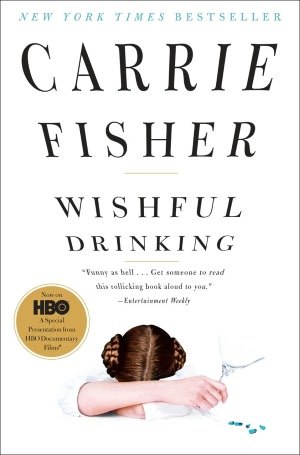
Review: Wishful Drinking - Carrie Fisher
This may as well be Carrie Fisher's book Wishful Drinking, a text adaptation of her successful one-woman stage show. Really, without much exaggeration, the paragraph above could well represent the entire lightweight 150+ pages. It's patently a cash-in from the stage show, which was was designed to be a humorous recollection of what led her from famous parents, through Star Wars to Simon, addiction and commitment to various asylums. Unfortunately this sight-gag-reliant, disjointed and vague approach is acceptable (even desirable) in a spoken word performance, it falls flat as a text.
| Image courtesy: barnesandnoble.com |
She gets more serious - but not much, given her stated aim of finding humour in the blackness - when writing of her issues with mental health. The book ends with a moving one-page tribute to those similarly afflicted, pleading for their everyday battle needs to be respected rather than shunned. Fittingly and redeemingly, it is the most coherent and lucid page of the entire book. The narrative style means Fisher's constant struggle with mental illness is danced around, but is the gravitas keeping the book from being not so much light as vaporous.
There is every chance my answer to the archetypal profile question "Who would you most like to have dinner with?" would include Carrie Fisher. This would be for reasons of then and now. (The second clip actually boasts many/most of the book's best gags.) While the botox-free 1982 version would be welcome for re-living my childhood and teen years, the 2012 edition would provide a completely different perspective on almost every conversation. As much as my teen self hates my 2012 version for writing it, this year's Carrie Fisher would take a seat at my table. However, this still can't make me recommend her book too highly - marbles - it loses something in translation. See the show instead.
Wednesday, October 26, 2011
Review: Future King by Larry Pontius
![]() |
| Courtesy: Amazon.com |
Let's break this down, slowly. And I'll put it in bold text just to emphasize the stones Pontius has displayed in doing so - he turns Prince Charles into an action hero - complete with witty catchphrases! Charles brandishes a 9mm assault rifle, gives "a tramp" the finger and also engages in repeated saucy banter with Camilla.
It goes without saying that this isn't, strictly speaking, a sequel. It uses some of the same characters, but the tone and style is so markedly different that there really isn't a comparison which pays appropriate justice to both this work and its inspiration.
It's essentially an engaging action thriller in which characterization of the royal family is a complete work of fiction. In fairness however, such Royal personality (if any exists) must be inserted either through surgical or imaginative means. Pontius is obviously bound - to set the novel any further forward in time means for difficulty painting a believable future landscape. However, it would also allow for completely fictional protagonists rather than inserting real people who may be delivering ill-fitting lines.
The pages will keep turning. You're never sure what to expect on the next page, aside from the occasional familiar set piece. Future King is an amusing read. Tennis Balls.
Wednesday, June 15, 2011
Review: Bradman's Invincibles - Roland Perry
Perhaps the most revered cricket team of all was the 1948 Invincibles, who completed an arduous six month tour of England without a loss. The tour was a perfect fusion of circumstance: Bradman's final First Class matches, a cricket-starved world following the Second World War needing non-combatant heroes and finally, a collation of talent probably unrivalled to that time.
In his work Bradman's Invincibles Roland Perry has created a perfunctory and informative book swayed obviously by his allegiance to Sir Donald Bradman. Perry, a writer with several books whose title include the words "Bradman" to his name, spent a number of years in conversation with Sir Donald Bradman and collaborated with him on several works, appears to think that Bradman's word on matters of cricket is absolute and completely true. He has taken every word he could trawl from his time spent with The Don and has turned it into a misguided four-hundred page tome where the point is almost indecipherable. What should have been a celebration has been turned into a trudging day-by-day commentary..
Bradman was undoubtedly the greatest cricketer of all time and even during the 1948 Invincibles tour where he turned forty, was Australia's best batsman. He has also suffered somewhat from revisionism, where posthumous revelations as to his character have begun to unfairly detract from his cricketing legacy. These "revelations" should only add to that legacy - of a genius batsman and excellent captain who wanted - and mostly got - his own way, often at others' expense. Any of his negative character traits are nonexistent on paper.
Relying on one source for the vast majority of one's sources is a mistake, both for one's credibility and entertainment purposes. The author has taken The Don's word as gospel in book which would be infinitely richer and more enjoyable for an Old Testament, Letters and Apocrypha. Perry has little affinity for beautiful prose, writing economically, repetitively and with no flair for either detail or accuracy. His style expects the reader to be in constant wonderment at the achievements of that squad rather than providing the full picture demanded by such an seminal tour.
Neither has Roland Perry skill of analogy, often comparing players across generations in a hackneyed and awkward style - even to the point of using the same comparison twice in three pages. There are several glaring factual errors and those who bridled against Sir Don Bradman's absolute rule are portrayed in an unflattering light. Though the book stretches to 430 pages, the last one-hundred and seventy of those are needlessly given over to potted biographies of the tourists and their vanquished opponents, which, while providing some interesting details is more an annoyance than enjoyable. This follows a passage where the author says it would be pointless to compare "Greatest Ever" teams and then proceeds to do so.
That's not to say that the book is devoid of redeeming features. Bradman's Invincibles provides an interesting peek into some aspects of cricket in the late 1940s, where towels were shoved under shirts and trousers became makeshift thigh and chest guards and breakfast in ration-enforced England consisted of half a piece of toast and a mushroom. The lack of net sessions was mildly surprising, but understandable given the amount of cricket played. Most surprising of all, perhaps, was that both Bill Johnston and Keith Miller often resorted to spin depending on the circumstances of the game; though this in itself is questionable given Perry's unfortunate failure to grasp the difference between leg- and off-cutters.
Bradman's Invincibles is hardly a revolutionary work. It holds interest - perhaps because it's the first cricket book I've read in months (years?) - but is disappointingly perfunctory and poorly rounded.
Golf balls (hit repeatedly against a tank stand with a cricket stump).
Image courtesy: borders.com.au (may they Rest In Peace).
Thursday, June 2, 2011
Review: And another thing... - Eoin Colfer
Eoin Colfer - he of the Artemis Fowl series - evidently has the same ability to ramble. However his contribution to the Hitchhikers' multiverse unfortunately loses steam and becomes less charming and more rambling as it proceeds. Undoubtedly a wonderful writer, Colfer turns phrases easily and thoughtfully, a quality which makes him a reasonable choice as H2G2 writing supremo. However, Douglas Adams had a remarkable knack of being able to knit a plot around his tangential observations that Colfer somehow lacks - you feel as if you are either reading a paragraph aimed at advancing the plot, or one aimed at making the reader snigger. While he's attempted quite successfully to mimic Adams' style, by the half way point many sequences have become interminable you realise the best characters, ideas and plotting were all Adams'.
This results in a book which feels awfully like the Star Wars prequels (ouch!) - the best ideas were the original ones and new "gimmicks" mostly fall flat. When riffing from the chords that Adams laid down, it's punchy and quite amusing. The premise (and plot) of the book is relatively clear - and remarkably straightforward for H2G2 - and Colfer's prosaic nous is evident throughout, the work lags badly and eventually becomes burdensome.That's not to say it's a bad book, but it feels like Colfer began by encouraging lightning to strike twice (or for a sixth time) and ends with his realisation that no-one can really write like Douglas Adams. Like other artists of the twentieth century - Adams' contemporary Graham Chapman, for example - he will be imitated but it's best to go your own direction with established characters. As an example - have you ever tried to write in someone else's style? It's hard. And apparently gets harder as you plug on through 273 pages.
Having not read any of Artemis Fowl I wasn't sure what to expect of the work, or my beloved H2G2 multiverse. You can't copy inspiration and expect the same results. Like Doctor Who after Russell T. Davies and The West Wing after Sorkin it's best to go in a different direction rather than using creative types with talents in different areas. It's a brave attempt and doesn't reflect badly on Colfer, but doesn't shine like Adams. In a word: expected.
Hitchhikers' fans should still read And Another Thing... but do so prepared to be left flat. First half tennis balls, second half golf balls.
Cover image courtesy: forbiddenplanet.co.uk