Showing posts with label Star Wars. Show all posts

Monday, April 16, 2012

Review: Wishful Drinking - Carrie Fisher

My Mum and Dad were two thirds of the Brad, Jen and Angelina of the '50s.  I love them both despite their flaws.  I did Star Wars.  I married, then dated Paul Simon.  A lot of his (depressing) lyrics are about me.  I have a sense of humour, which is a really good thing.  I was addicted to a whole bunch of drugs and alcohol.  I wrote a novel about it, and my famously dysfunctional family.  A gay friend of mine once died in my bed which gave me PTSD.  My second husband left me for another man, which messed with me even more.  Through all this, I was bipolar, but didn't know it.  When I did, I received electroshock therapy, meaning I can't remember much.  I'm now under treatment and living a more centred, normal life than ever before.

This may as well be Carrie Fisher's book Wishful Drinking, a text adaptation of her successful one-woman stage show.  Really, without much exaggeration, the paragraph above could well represent the entire lightweight 150+ pages.  It's patently a cash-in from the stage show, which was was designed to be a humorous recollection of what led her from famous parents, through Star Wars to Simon, addiction and commitment to various asylums.  Unfortunately this sight-gag-reliant, disjointed and vague approach is acceptable (even desirable) in a spoken word performance, it falls flat as a text.
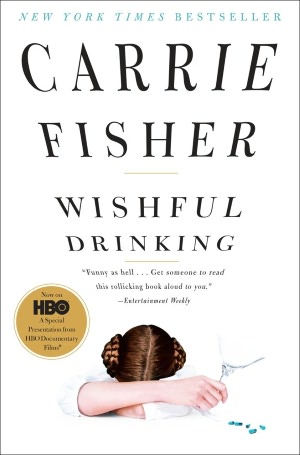
Image courtesy: barnesandnoble.com
The other reason for this eclectic authorship is a result of Fisher undergoing electroshock therapy for mental illness.  This means she simply doesn't remember much of her life, as the treatment rendered whole chunks of her past are a virtual nonevent.  Being unable to recall much of one's life has the capacity to make a memoir either oddly ethereal or painfully shallow.  Fortunately, Fisher stays mainly with the former and the book accurately represents what she remembers of her life - a series of unconnected events with their nascence stemming from a naive showbiz upbringing, early fame and drugs. 

She gets more serious - but not much, given her stated aim of finding humour in the blackness - when writing of her issues with mental health.  The book ends with a moving one-page tribute to those similarly afflicted, pleading for their everyday battle needs to be respected rather than shunned.  Fittingly and redeemingly, it is the most coherent and lucid page of the entire book.  The narrative style means Fisher's constant struggle with mental illness is danced around, but is the gravitas keeping the book from being not so much light as vaporous.

There is every chance my answer to the archetypal profile question "Who would you most like to have dinner with?" would include Carrie Fisher.  This would be for reasons of then and now.  (The second clip actually boasts many/most of the book's best gags.)  While the botox-free 1982 version would be welcome for re-living my childhood and teen years, the 2012 edition would provide a completely different perspective on almost every conversation.  As much as my teen self hates my 2012 version for writing it, this year's Carrie Fisher would take a seat at my table.  However, this still can't make me recommend her book too highly - marbles - it loses something in translation.  See the show instead.

Monday, January 17, 2011

Review: Star Wars: Darksaber by Kevin J. Anderson


I saw this book for a dollar at my local second-hand book store and bought it not expecting much. Darksaber was one of the earlier Star Wars "expanded universe" books (published 1995) and I loved the series as a sixteen year old, so I decided to take a punt so I spent my loonie and got only a fraction of the pulpy escapism I expected. Pulp sure, but about as escapist as the Birdman of Alcatraz.

Unfortunately it was a poorly-written attempt to cash in on Anderson's prior Star Wars novels - his "landmark" Jedi Academy trilogy. Like all Star Wars set pieces Darksaber features a superweapon in the hands of the bad guys - the Hutts this time, with yet another bloody Death Star revisit - and Imperials who, though scattered in the last "canon" book are suddenly a force to be feared again. It goes without saying that the Rebel Alliance, sorry - Galactic Alliance - triumph at the end.

Disappointingly characterised, Anderson seemed to think copying George Lucas's hackneyed dialogue straight from the first three Star Wars movies passes as convincing interplay, forgetting that he's stealing words from probably one of the worst screenwriters of all time, and that Lucas`s style works much better on celluloid than paper. The `Chancellor of the Star Wars Universe` doesn't appear comfortable writing any intimate scenes as Luke Skywalker and his new love interest seem about as passionate as cardboard while Han and Leia`s marriage seems to be more `for the kids`than for themselves. The less said about Wedge Antilles and his bird (literally, bird) the better. You care for the characters as portrayed about as much as you do for your own toenail clippings.

Apparently creating a character worth investing in is illegal in The Expanded Universe, so when Luke and his girl are trapped on Hoth, they find themselves confronted with the same Wampa Ice Creature who`s arm he severed at the start of Empire. I mean, Lucas himself stretched credibility to beyond breaking point by using essentially the same characters in both trilogies, making us think that the Galaxy is populated by about 20 people and a bunch of Stormtroopers, but this is just ridiculous. If you want new ideas, don`t read Kevin Anderson.

Any traits a character may have are simply for the purposes for plot, which makes the 480-some pages both direct, unengaging and a waste of forest. Worse still, plot threads appear and disappear as a matter of convenience rather than building to any sort of climax. The titular Darksaber weapon is the greatest of these and its existence seems only to provide a base for ineffective, unmemorable villainy of the most banal kind. To add injury to insult, it`s disposed of with less care and interest than one throws away a crisp packet, as if Anderson realised four-fifths through writing that the Imperial rabble, though less threatening than at any time throughout the canon, were more interesting than the Hutts and disposed of the book`s raison dètre without thinking even once.

Overall, it's a page-turner simply because you can kind of - if you squint a bit and stretch the friendship to breaking point - identify with Han, Leia and Luke - no, sorry, not Luke because apparently being a Jedi de-emotionalises into becoming a one-note bore - but the book leaves you feeling blah about finishing it and reading even the more well-crafted Star Wars novels. It does this because it doesn't reflect any of the spirit of Star Wars - the fun that Cowboys and Indians in space became for us all.

Star Wars: Darksaber by Kevin J. Anderson scores only marbles.
Image courtesy http://www.coverbrowser.com