Thursday, April 26, 2012

Review: Sheilas, Wogs and Poofters - Johnny Warren

This is my second foray into Australian soccer literature, the first having been less than impressive. The good news is that the now 10 year old 'Sheilas, Wogs and Poofters' by the late Johnny Warren is far better, the bad news is that Warren fell into the standard traps of all passionate Australian soccer figures.

Warren had an amazing playing career for someone growing up in Australian during the 1950's where soccer was third or fourth on the list of priorities for most young men (particularly Anglo ones such as Warren). As is fairly portrayed by Warren's title, a fair amount of tasteless stigma was also labelled at those playing the game.

Given the options available to Warren he managed to forge a club and international career that deserves celebration. Representing the St George (Budapest) club with great distinction Warren no doubt had to prove himself able to transcend ethnic boundaries; 40 odd matches for Australia (including the 1974 World Cup) showed much dedication at a time when it was hardly a glamourous lifestyle.

The matches the Australian team of the late 1960's and early 1970's deserve legendary status, not just for the achievements of the team but for the scenarios in which they played. The Friendly Nations cup played as an olive branch to the Vietnamese people by the Western anti-communist forces is an amazing tale for the conditions (warfare) that the tournament was played within. As well Warren eulogises on some of his contemporaries who should receive more credit for their skills by those who believe that legendary status in Australian soccer began with Viduka and Kewell et al.

For the non devoted supporter of soccer in Australia there are two general criticisms that can be labelled at the sport in this country. Number one is that it is constantly racked with in fighting and controversy. Number two is that the sport needs to learn to stand on its own two feet and fight for its place in the landscape; rather it constantly complains about the level of media coverage afforded Australian Football or Rugby League over itself. Warren in the last third of the book spirals violently into into these two criticisms and never recovers. If those in charge of the sport believe it is the best sport then they need to rise above arguing internally or complaining about the competition and simply produce a product that attracts the masses.

Recommend this book for a read and a good summary history of the sport in Australia and an interesting life story that is at the same time stereotypically Australian, but also very different from your usual sporting heroes. Tennis Balls.

Cover image thanks to amazon.com.au

Tuesday, April 24, 2012

Review: Game for anything - Gideon Haigh


If Bill Simmons is the everyman sportswriter full of pop culture, in-jokes and homer-isms, then Gideon Haigh is his antithesis. You read Simmons as he thinks aloud, a man down at the bar with his mates. However, he's just self-aware enough to know that because he monopolises the conversation he should fling jokes about to keep his audience engaged. There's obvious research, but done on the sly; he's no stat-geek, but muses on feel and zeitgeist.

Haigh, deliberately and with culture incomparable, compiles cricketing words that evokes a history professor's magnum opus. Immaculate research, mirrored by thoughtful prose. Simmons' raison d'etre is entertaining learning. For Haigh, it is the reverse. And they're both brilliant.

Cover image courtesy: tower.com
Haigh's 2004 compendium “Game for Anything” released in Australia his collected writings for publications such as Wisden Asia and the now-defunct periodicals The Bulletin and Wisden Cricket Monthly. It features several learned insights into periods of the game about which I, a studious and informed cricket fan, knew very little. Each essay is structured magnificently, being economical yet descriptive; each word is steeped in context. That he quotes an assortment of historical figures from Jardine Machiavelli to Mark Waugh exemplifies his remarkable reading range.

In fact the stand-out point of Haigh's work is just that – his research. Articles are based not around his palpable love of the game, it's correct spirit and statutes; his writing is revolves around a prescient “angle” and why it emerges as such a story from a multi-textured background.

There are elements of whimsy as well: he defines his favourite cricketer as the English batsman Chris Tavare, decries the rise of park cricket sledging and, most beautifully of all, develops delicate snapshots of cricket history. These short trips are, unlike the footage that comprises most of our memories, full-colour and high-definition – he makes Bradman more than ridiculous numbers and grainy footage of a fourth-ball duck.

Perhaps what's most remarkable about his text is how easily he makes just the right words fit together on paper. Despite obvious labour over books, newspapers, journals and microfiche, Haigh's words appear with economic precision – as if he has the most severe of editors. When writing for a mass audience using such a scholarly approach, Haigh is to be praised and respected for balancing intellect with ease of reading. Characters like Lawrence Rowe, Richard Wardill and characteristics such as gambling are all treated with the same laconic, precise respect.

If you learn about politics from a book by a political master, you learn about cricket from Haigh – far more than from any other writer today. His words lack Roebuck's flair but also his occasional florid tones. He analyses the game from a removed, scholarly position; writing not because he loves the game (although he does) but because he feels it has stories to tell. In the prologue, he encourages young writers to do likewise. A memorable example was my favourite essay from Game for Anything, concerning the late-19th century Australian captain Harry Trott and his commitment to Kew Asylum.

Highly recommended, scoring footballs.

For a different perspective, the SMH also reviewed this work.

Saturday, April 21, 2012

Review: And God Created Cricket – Simon Hughes

Former veteran county cricketer now cricket journalist Simon Hughes posits this work as being something of an antithesis to the efforts provided by most cricketing historians. Hughes even goes as far to mention that those works developed by ex-Prime Ministers are too serious. 'And God Created Cricket' is a light hearted romp through centuries of cricket (not to mention debauchery, skulduggery, and downright bad manners).

Hughes has researched others works to provide the flow of events from which he latches onto the more obscure notes of players and matches and embellishes the stories to their full extent. One must credit Hughes for sticking to the historical script well, providing those with less desire for details, a work of ease to get a picture of the history of cricket. But there are flaws.

Firstly, as a tabloid journalist one should not be surprised, Hughes seems incapable of allowing a chapter to pass without finding need to mention or compare cricket to Premiership Football. Really if you had never heard of Hughes the cricketer (and likely given his mediocre career you would not have) you would think that he is a Football journalist trying his hand at something new. Some of the references are just a waste of words. Cricket has a history longer and with far greater depth than any football code, to feel it necessary to attract readership this way is missing the point.

Secondly, there are a number of errors throughout the book, the sort of errors that should never get through good proof reading and editing, but they did. These are not errors of judgement in interpreting history but errors of name. The 1930's Australian batsman was Vic Richardson, not Viv; and the bowler Fleetwood-Smith's Christian name was not Laurie, but Leslie and in fact he was better known as 'Chuck'. Simple things that with some care would have been avoided and may have helped the more educated readership enjoy the book more.

Fair is fair, as a cricketing purist I was unlikely to rate this book above Tennis Balls when I seek so much from cricketing literature, but it does not even make this.  Marbles.

Image thanks to telegraph.co.uk

Monday, April 16, 2012

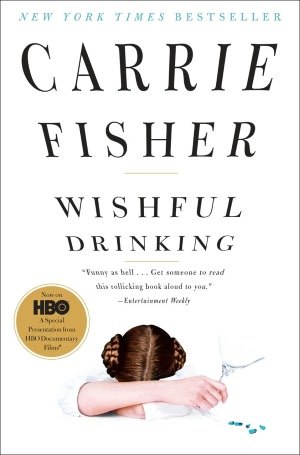
Review: Wishful Drinking - Carrie Fisher

My Mum and Dad were two thirds of the Brad, Jen and Angelina of the '50s.  I love them both despite their flaws.  I did Star Wars.  I married, then dated Paul Simon.  A lot of his (depressing) lyrics are about me.  I have a sense of humour, which is a really good thing.  I was addicted to a whole bunch of drugs and alcohol.  I wrote a novel about it, and my famously dysfunctional family.  A gay friend of mine once died in my bed which gave me PTSD.  My second husband left me for another man, which messed with me even more.  Through all this, I was bipolar, but didn't know it.  When I did, I received electroshock therapy, meaning I can't remember much.  I'm now under treatment and living a more centred, normal life than ever before.

This may as well be Carrie Fisher's book Wishful Drinking, a text adaptation of her successful one-woman stage show.  Really, without much exaggeration, the paragraph above could well represent the entire lightweight 150+ pages.  It's patently a cash-in from the stage show, which was was designed to be a humorous recollection of what led her from famous parents, through Star Wars to Simon, addiction and commitment to various asylums.  Unfortunately this sight-gag-reliant, disjointed and vague approach is acceptable (even desirable) in a spoken word performance, it falls flat as a text.

Image courtesy: barnesandnoble.com
The other reason for this eclectic authorship is a result of Fisher undergoing electroshock therapy for mental illness.  This means she simply doesn't remember much of her life, as the treatment rendered whole chunks of her past are a virtual nonevent.  Being unable to recall much of one's life has the capacity to make a memoir either oddly ethereal or painfully shallow.  Fortunately, Fisher stays mainly with the former and the book accurately represents what she remembers of her life - a series of unconnected events with their nascence stemming from a naive showbiz upbringing, early fame and drugs. 

She gets more serious - but not much, given her stated aim of finding humour in the blackness - when writing of her issues with mental health.  The book ends with a moving one-page tribute to those similarly afflicted, pleading for their everyday battle needs to be respected rather than shunned.  Fittingly and redeemingly, it is the most coherent and lucid page of the entire book.  The narrative style means Fisher's constant struggle with mental illness is danced around, but is the gravitas keeping the book from being not so much light as vaporous.

There is every chance my answer to the archetypal profile question "Who would you most like to have dinner with?" would include Carrie Fisher.  This would be for reasons of then and now.  (The second clip actually boasts many/most of the book's best gags.)  While the botox-free 1982 version would be welcome for re-living my childhood and teen years, the 2012 edition would provide a completely different perspective on almost every conversation.  As much as my teen self hates my 2012 version for writing it, this year's Carrie Fisher would take a seat at my table.  However, this still can't make me recommend her book too highly - marbles - it loses something in translation.  See the show instead.

Tuesday, March 27, 2012

Review: Fragile Things - Neil Gaiman

I'd heard so much about Neil Gaiman.

He's probably the most followed auteur author on Twitter, he wrote a quality episode of my favourite TV programme (Doctor Who - The Doctor's Wife), I loved the movie Stardust and he's become a sort-of geek Elvis.  Inspired, I reserved a copy of a short story collection from my local library, my first Gaiman.

I hope I chose poorly.

Fragile Things is a collection of short stories and poetry that Gaiman was commissioned to write for various collations.  It begins with a twenty-odd page exploration into the roots of each tale, during which he writes about a time where he began to collaborate with master of the genre Harlan Ellison.  He says that Ellison had to finish one of his own works, and told Gaiman to begin work on their short story and he'd catch up.  When he returned, he told Gaiman "No, not doing it - it reads like Neil Gaiman".  This could perhaps sum up the book better than any of my observations: Gaiman has his own recognisable style which he pairs with a varying tone from story to story.

Which is fine, of course, expected even - except when the stories aren't grabbing the reader.  The title, Fragile Things, is perhaps the most enjoyable aspect of the work, for it perfectly describes Gaiman's writing.  He uses each word precisely, delicately and lightly, giving the reader the feeling that should they close the book too quickly, the words of the text will dislodge and flutter into disorder.  He writes like one assembles a jigsaw - there is no alternative but to be precise.

Courtesy: Jar of Juice
He is an artisan, respectful of the written word and it's propensity misuse and so writes with paramount agility.  Unfortunately for my preferences though, his deftness with sentence construction is paired with a minimalist approach to storyline; this collection comprises mainly beautifully constructed scenes which rarely tell the end of the tale.

The stories within are immaculate games of "What If...", leading to a number of unusual situations, but often lack resolution.  In many ways, this book is like a lighter collection of Coen Brothers short films - stuff happens and then the movie ends.  Given my past reviews, it should come as no surprise  that resolution forms a key part of my literary enjoyment.  Gaiman, like the Coens, aren't strong on this and prefer to present interesting scenes that leave the reader where the artist started - with a "What about..."

In Volume One of his prison diaries, Jeffrey Archer wrote about creating short fictions.  When doing so, he said, it was imperative to have the end in mind.  A novel could be plotted logically and, although needing to collect tension properly and avoid any Deus ex machinae, didn't need a hard ending in mind when writing began.  Archer is obviously from a completely different school of writing from Gaiman, but there is reason to his statements.  Gaiman can ignore them simply because these short fictions rarely led anywhere, much less a conclusion.

I'm looking forward to my next tryst with Neil Gaiman, if only because I'm positive (or at least hoping) that I'll enjoy it more than this load of marbles.

Related review: Stardust - Neil Gaiman

Saturday, March 10, 2012

Review: More Than a Game - John Major

I really do need to admit that although being a born and bred Australian I am spending more and more time putting my head above the neighbouring fence and enjoying the delights of sport as enjoyed by the English. This is quite the admission, and flies in the face of everything I learned from the likes of Dean Jones, Allan Border, and Steve Waugh. English cricket to them was defined by failure and therefore very much the lesser when compared to Australia's ruthless winning culture (even when losing), but I am no longer of the same opinion and not just because Australia has lost the past two Ashes series.

The real sticking point that for my mind that Australian cricket falls short of is its cultural impact. While we cannot deny that cricket remains a strong part of Australian culture, for the English over the past 250 years it is clear that cricket has has gone beyond merely being a part of and driven culture. Australian cricket has not shifted society as English cricket did. While Australians often pointed to the archaic distinction between amateurs and professionals (upper and lower classes) as being disgraceful, the reality is that such distinctions were well established in English society at large. While cricket did indeed choose to accept and incorporate them into it's play, it became a microcosm for the observation of social distinctions highlighting their hypocritical nature and ultimately doing away with them.

Without becoming a screaming Anglophile let us not forget that there are plenty of parts of Australian cricketing history that one may choose to let lie when all is said and done. Cricket historians may eventually afford the words 'mental disintegration' the same level of disgust and horror as has already been attributed 'bodyline'.

Cricket became for England a pastime upon which a nations leisure revolved, as John Major title's his book it is 'More Than a Game' with many famous cricketing names being non-players. How many sports or leisure activities honour journalists and administrators to the same degree as cricket does? Not to mention those who were patrons of the game. How many sports have entire wings of literature (fiction and non-fiction) devoted to them, not to mention certain religious understandings being exemplified as was 'Muscular Christianity' – although a nod must go to Rugby for its theological input as well.

Major brings all of this together in a tremendous work of historical review. His purpose is to describe what he believes are the lost centuries of cricket. Crickets actual beginnings likely will never be known but positive evidence for it existing in 17th century England exists. Major takes the reader on a journey to understand these earliest moments of the game he loves, and how the gradual shift in English society was mirrored by the growth that became an empires favourite pastime.

This is not a book for the casual cricket lover so be wary. It is as full of detail as any book I have ever read. Major profiles at length the characters and teams that made up the game in each moment through history. It would be hard pressed to accept this as a good read based on that description but honestly I could not put this book down and wished it would never end.

Cricket tradition is not what it is often made out to be in 21st century Australia. Modified versions of the game did not originate with 50 over cricket or receive an injection of charisma upon the 'revolution' that is T20. Afford yourself a peruse at the very least of Wikipedia and you will find men of the like of Billy Beldham entering into one on one contests of gladiatorial nature in the late 18th and early 19th centuries, or the entrepreneurial William Clarke leading his 'All-England XI' around for invitational games often against the odds. You see cricket has always evolved, tradition did not originate with Chappell brothers or even Sir Donald Bradman, cricket history runs much, much deeper.

The flow of the work is exceptional by Major. For chapter upon chapter he builds a chronologically based picture of the games history. But just at the right moment when the reader needs a rest he pauses to reflect on specific persons or positions in the game of cricket. Although counter to the rhetoric of most latter day Australian players, cricket is not limited to those privileged enough to be blessed with the skill to play. Major honours with specific chapters the patrons and administrators, scorers and journalists who do not play but their involvement requires no less admiration. They like Major, loved it unconditionally even though they may not have been able to bowl with the fire of Fred Spofforth.

Of course Major is a former British Prime Minister, and a small litter of political gibing can be found in this books pages. But we will forgive him this as politics has been his life. (Major may still wake every night trying to explain to the long gone British public that 'New Labour' is not what you think it was, before cuddling up to his soft Mrs Thatcher doll and going back to sleep).

English cricket is a cultural phenomenon, not just a sport. Cricketers all over the world today are treading well worn paths and carrying a beacon for a culture that has a long history. They are by far not the first, nor will be the last to enjoy this great game. Basketballs.

Cover image thanks to thebookpeople.co.uk

Thursday, March 8, 2012

Review: The World Game, The Story of How Football went Global - Les Murray

A book covered in infamy upon its release. Murray initially chose to state Socceroo captain Lucas Neill as the leading mercenary against coach Pim Verbeek, then upon threat of legal action, grievous bodily harm and stigmata elects to withdraw the statements. The book really did not get much better than the confusing episode that preceded it in my attention.

Lets begin with the accusatory statements that the copy I read retained. Just the quick way the incident is skimmed over, one paragraph enough apparently for one of the most dramatic stories to come of the 2010 World Cup campaign, left me amazed. Surely such an incident was worthy a chapter, some attempt at corroboration? In reality we do not know what is truth and what is not – if there was not some truth to it why did Murray put it in in the first place? If there was why did he retract the statement so willingly and declare he had falsified them? Absolutely ridiculous yet pretty standard for a book that has no idea where it is going or what its purpose is.

There is a positive, and to not afford Murray his due for this would be wrong. Murray has chosen to highlight footballers and teams that he believes are the best ever. His choices open the mind of the casual observer such as myself up to learning of names such as Di Stefano and Garrincha who were greats of the game yet escape mainstream notoriety such as Maradona and Pele. Maradona and Pele are indeed profiled, and worthy praise is afforded them, however Murray steers clear of players such as David Beckham or Wayne Rooney. To him these latter day notables are notable for more than simply being great footballers, but also a product of the English style of play that he regularly turns his nose up at through the book.

As a footballing purist it is absolutely with an educated eye that Murray passes judgement on the English game, while also holding up that which has been played in Eastern Europe and South America. Murray though labours the point and many others over and over again, so much so that the reader spirals in and out of deja vu. The tragedy that was the Hungarian national teams failure to win the final of the 1954 World Cup must be explained in agonising detail multiple times according to Murray. Psychologists at the ready, Murray (born László Ürge in Hungary) has still not reached 'closure' on this boyhood heartbreak 57 years later. This is not the only repetition.

Diego Maradona is Murray's choice as the greatest footballer of all. Murray waxes lyrical about his stardom back in Argentina, his struggles at Barcelona, his adoption as a Neapolitan, and of course his heroic leadership of Argentina to World Cup glory in 1986. But Murray admits to the star of Maradona being tarnished with his drug abuse and of course the 'Hand of God' goal on his way to lifting the 1986 World Cup. Murray provides a well balanced and thoughtful analysis of the latter incident. Next chapter however has Murray running through an explanation of every World Cup ever held, the highlights and star players. Come 1986 what do we read? A well balanced and thoughtful analysis of the 'Hand of God' incident, again.

There are also contradictions from one chapter to the next further confusing the reader and making it clearer again the book was written in a patchwork format and without central purpose. One chapter Murray criticises heavily the moves in 2003 and 2004 to remove the ethnically tied clubs from being part of a national league, as to him this was a slap to those who kept the game going all the years. Yet in the next chapter Murray is singing the praises of Frank Lowy for his leadership in bringing about the A-League – hang on Les you cannot have it both ways?

Except that you will derive enjoyment from learning sporting history otherwise unknown as a sporting nerd the book serves little purpose and receives Marbles - just.

Cover image thanks to fishpond.com.au