Monday, July 2, 2012

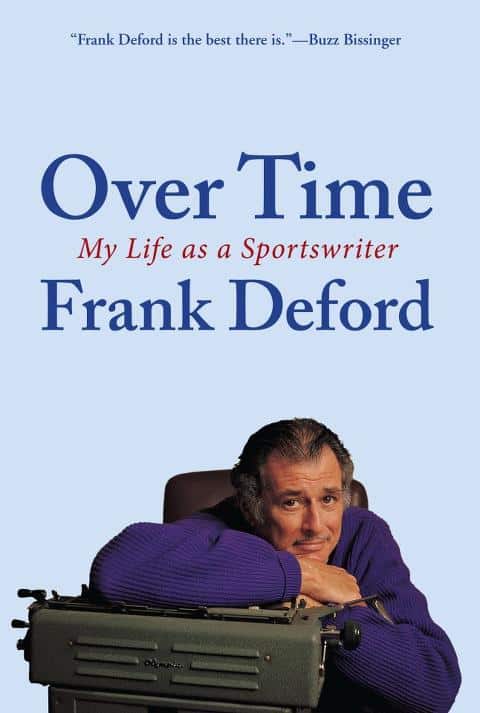
Review: Over Time - Frank Deford

courtesy: livetalksla.or
Frank Deford talks of his work Over Time not as a memoir but a we-moir, a collation of transient connections with figures more famous than himself. When asked to write a piece for alma mater Sports Illustrated about his early days at the United States' foremost sports magazine, he initially resisted; but as it became obvious there was a desire for a Mad Men style homage to the golden age of US magazines, no-one was in a better position to detail those salad days of the sixties.

Were you to boil down Deford's style to a single adjective, it would be wry. He is observant yet economical, distilling major events and people into their vital alchemy and transmitting what he absorbs with a pleasant mix of good humour and gravitas. He has used the same affable style for fifty years, through books, editorials and myriad essays; the result is four-hundred-odd pages of brilliant simple statements. In fact, Deford writes with vision and simplicity that makes readers often think “Why didn't I see it that way before?”

This geniality is only magnfied by an attitude of supreme moderation. Deford is a sporting centreist – as he proves with his weekly NPR commentaries – well aware of the unique position sport occupies in our cultural landscape. At a recent speech at the Seattle Public Library, he suggested both the import and triviality of sport by announcing the only two unnecessary cultural phenomena developed individually by every people have been sport and religion.

Acutely aware of his position as an observer rather than newsmaker, he presents his life journey quite superficially and bases his experiences around those in public life who were attracting the same attention. Where he writes about personal matters, it is almost entirely in regard to his artisanship, or concerning the athletes were the root source of his material and observations. A perfect example comes from one of the work's final chapters where he talks with shark Jimmy the Greek about their shared loss – children lost to Cystic Fibrosis.

This isn't your typical me-me-me book, detailing “my struggle against the odds” or a list of accomplishments made more impressive when taken out of context. Deford freely admits to benefiting from luck and the era in which he got his start. His writing is about his profession, rather than himself and as such you find yourself knowing less of the man than you would choose; no doubt Deford prefers this way. He revels in what he has seen throughout his career, being able to witness the triumph and despair that's inherent at any sport; at the same time however the career is obviously only part of the man.

However, because his scope spans five decades, he really does no more than touch upon so many of the topics that could conceivably sell Over Time: these are anecdotes of his time observing sport, rather than his opinions. The stories are personal and not hearsay; a particular example being when he caught a train with a young Muhammad Ali and found him searching for spiritual and emotional understanding, exploring that which would make him controversial. In this manner, his writing on Arthur Ashe is sad but upbeat and the reader absorbs Deford's patent respect for the great tennis player.

As a text for aspiring sportswriters it has no definite teaching points, or at least very few. Deford's lack of personal conceit contributes to this somewhat; his belief is that writing is something you can or can't do, something rarely learned well. This seems partially a cover for such a humble man about whom his craft agrees that he is the patrician.

While there are few absolute commandments, the aspiring blogosphere would do well to heed his obvious breadth of vision. The value of a broad intake of news and views is tacitly suggested, as being well-rounded provides writers with the ability to place sport and the context from which stories emerge into a more global spectrum.

It's a wonderful piece of writing. But from Frank Deford, would you expect anything else?

Footballs.

Suggested other reviews:


Monday, May 21, 2012

Review: Death of Kings - Bernard Cornwell

Death of Kings is the sixth book in Cornwell's Saxon Tales, which chronicle the birth of England as a united land around the turn of the tenth century.  It is very much a case of "more of the same" by the author, who delivers one of his more workmanlike novels of his twenty-plus year career.

It goes without saying that Cornwell's research and ability to insert his characters into key points in history are excellent: it is what he does.  Steve Martin makes jokes, water is wet, sickness is not nice and Cornwell will compile immaculate situations, described well and totally contextual.  In fact, Death of Kings is so heavy in a major historical event that the storytelling actually suffers a little.

That event, the death of Alfred the Great and subsequent scrabble for the throne, sees the focus rest with the family of the only Saxon/English monarch to have the title "the Great".  That means that three so-far background characters - Alfred's sons Osferth and Edward as well as his nephew Aethelwold - occupy much of the foreground.

As the two sons play a role in the notional correct inheritance, they are afforded character development which really isn't present for many of the other characters.  Aethelflaed, obviously one of Cornwell's muses, has her role somewhat minimised, while the book's major protagonist Uhtred drives the plot as usual.  With the throne's occupancy somewhat unsettled, the storyline feels similarly transitory - a placemarker until the Saxons move forward into regaining territory lost to the Danish invasions.

The book does thaw of relations between Uhtred and Alfred while the latter lies upon his deathbed.  Despite five earlier episodes and both men over 40 (the middle-ages equivalent of 60 or more) their relationship of respect without liking each other had, as the characters, grown old.
Perhaps as a result of the rise in characters like Osferth in combination with the brutal and violent nature of military battles of the era, sees more of Uhtred's inner circle of warriors dying than for many years.  In the tenth century, warriors wouldn't live to their forties unless they were excellent/smart/lucky, so for Uhtred's cohort of men to make it through the past two books relatively unscathed is something of an anomaly.

While still engaging, Death of Kings lacks some of the easy congruency of the past three Saxon Tales, earning it a rating of tennis balls.

Monday, May 7, 2012

Review: Stardust - Neil Gaiman

Don't try and take a purposeful walk with Neil Gaiman.  It'll take forever, you'll stop and smell myriad roses and probably end up never getting where you want.  In short, you'll meander, often simply for the sake of it, and he'll keep your attention for a while, but often be left feeling that the whole exercise was pointless.

The journey can be the reward ... but sometimes that reward is unsatisfying and annoying.

I've tried, wanted, to like Gaiman now - two times - and failed.

Stardust is one of my all-time favourite movies.  It's certainly got to be right up there - it features a predictably callow youth coming of age story, plenty of imaginative fight scenes, a strong - climactic - ending, wonderful sense of humour and  features all of Dexter Fletcher, De Niro, Ricky Gervais, Jason Flemyng, Mark Strong, Michelle Pfeiffer, a chick from Coupling and Claire Danes. 

Yes, Fletcher is listed first because he was in one of my kiddie favourites (Press Gang) and Lock, Stock and Two Smoking Barrels.  Perhaps that's where the disconnect occurs: the producer of that seminal modern East-end gangster film was Matthew Vaughn, who directs the feature version of Stardust.  He obtained its rights at no cost from Gaiman, who thought he could do a good job in bringing it to life.  It turns out I like Matthew Vaughn's work a lot more than Neil Gaiman's.  This is one of those rare movies where it exceeds the work from which it grew.

http://englishmajorjunkfood.com/
Gaiman's version reads much the same as the first two thirds of the movie, but with the author's typical homespun feel.  While, alongside his delicate, graceful prose, this ability to create believable, real-world fantasies stands as (in my opinion) his greatest skill, this realism doesn't translate through to a big-screen fantasy.  Celluloid, for obvious reasons, plays up popular emotions like love, romance, intrigue and adventure.  Gaiman's style is to do quite the opposite, creating an interesting world with complex, engaging characters motivated by "real" human emotions.

The result is that the novel enchants you for the first sixty pages, then continues and finally peters out with about thirty pages remaining.  There isn't so much a climax, as a slow recession into nothingness like an old man trying to vocalise lost thoughts.  It's not bad, and quite enjoyable, but leaves the reader somewhat disappointed at the lack of climax.  It doesn't feel like it's missing a sword fight, or a great happy ending; just that the final pages see a bunch of interminable meandering, as life would generally provide.

Unfortunately, Gaiman is writing (mostly, up to this point, very well) a fantasy.  We don't want real-world finishes, or at least, I don't.  I want an inventive solution which isn't a deux ex machina.  Gaiman creates wonderful starts, beautiful situations, yet Stardust only strengthened a burgeoning belief that this is his forte, rather than pursuing a narrative.  Tennis balls.

Thursday, April 26, 2012

Review: Sheilas, Wogs and Poofters - Johnny Warren

This is my second foray into Australian soccer literature, the first having been less than impressive. The good news is that the now 10 year old 'Sheilas, Wogs and Poofters' by the late Johnny Warren is far better, the bad news is that Warren fell into the standard traps of all passionate Australian soccer figures.

Warren had an amazing playing career for someone growing up in Australian during the 1950's where soccer was third or fourth on the list of priorities for most young men (particularly Anglo ones such as Warren). As is fairly portrayed by Warren's title, a fair amount of tasteless stigma was also labelled at those playing the game.

Given the options available to Warren he managed to forge a club and international career that deserves celebration. Representing the St George (Budapest) club with great distinction Warren no doubt had to prove himself able to transcend ethnic boundaries; 40 odd matches for Australia (including the 1974 World Cup) showed much dedication at a time when it was hardly a glamourous lifestyle.

The matches the Australian team of the late 1960's and early 1970's deserve legendary status, not just for the achievements of the team but for the scenarios in which they played. The Friendly Nations cup played as an olive branch to the Vietnamese people by the Western anti-communist forces is an amazing tale for the conditions (warfare) that the tournament was played within. As well Warren eulogises on some of his contemporaries who should receive more credit for their skills by those who believe that legendary status in Australian soccer began with Viduka and Kewell et al.

For the non devoted supporter of soccer in Australia there are two general criticisms that can be labelled at the sport in this country. Number one is that it is constantly racked with in fighting and controversy. Number two is that the sport needs to learn to stand on its own two feet and fight for its place in the landscape; rather it constantly complains about the level of media coverage afforded Australian Football or Rugby League over itself. Warren in the last third of the book spirals violently into into these two criticisms and never recovers. If those in charge of the sport believe it is the best sport then they need to rise above arguing internally or complaining about the competition and simply produce a product that attracts the masses.

Recommend this book for a read and a good summary history of the sport in Australia and an interesting life story that is at the same time stereotypically Australian, but also very different from your usual sporting heroes. Tennis Balls.

Cover image thanks to amazon.com.au

Tuesday, April 24, 2012

Review: Game for anything - Gideon Haigh


If Bill Simmons is the everyman sportswriter full of pop culture, in-jokes and homer-isms, then Gideon Haigh is his antithesis. You read Simmons as he thinks aloud, a man down at the bar with his mates. However, he's just self-aware enough to know that because he monopolises the conversation he should fling jokes about to keep his audience engaged. There's obvious research, but done on the sly; he's no stat-geek, but muses on feel and zeitgeist.

Haigh, deliberately and with culture incomparable, compiles cricketing words that evokes a history professor's magnum opus. Immaculate research, mirrored by thoughtful prose. Simmons' raison d'etre is entertaining learning. For Haigh, it is the reverse. And they're both brilliant.

Cover image courtesy: tower.com
Haigh's 2004 compendium “Game for Anything” released in Australia his collected writings for publications such as Wisden Asia and the now-defunct periodicals The Bulletin and Wisden Cricket Monthly. It features several learned insights into periods of the game about which I, a studious and informed cricket fan, knew very little. Each essay is structured magnificently, being economical yet descriptive; each word is steeped in context. That he quotes an assortment of historical figures from Jardine Machiavelli to Mark Waugh exemplifies his remarkable reading range.

In fact the stand-out point of Haigh's work is just that – his research. Articles are based not around his palpable love of the game, it's correct spirit and statutes; his writing is revolves around a prescient “angle” and why it emerges as such a story from a multi-textured background.

There are elements of whimsy as well: he defines his favourite cricketer as the English batsman Chris Tavare, decries the rise of park cricket sledging and, most beautifully of all, develops delicate snapshots of cricket history. These short trips are, unlike the footage that comprises most of our memories, full-colour and high-definition – he makes Bradman more than ridiculous numbers and grainy footage of a fourth-ball duck.

Perhaps what's most remarkable about his text is how easily he makes just the right words fit together on paper. Despite obvious labour over books, newspapers, journals and microfiche, Haigh's words appear with economic precision – as if he has the most severe of editors. When writing for a mass audience using such a scholarly approach, Haigh is to be praised and respected for balancing intellect with ease of reading. Characters like Lawrence Rowe, Richard Wardill and characteristics such as gambling are all treated with the same laconic, precise respect.

If you learn about politics from a book by a political master, you learn about cricket from Haigh – far more than from any other writer today. His words lack Roebuck's flair but also his occasional florid tones. He analyses the game from a removed, scholarly position; writing not because he loves the game (although he does) but because he feels it has stories to tell. In the prologue, he encourages young writers to do likewise. A memorable example was my favourite essay from Game for Anything, concerning the late-19th century Australian captain Harry Trott and his commitment to Kew Asylum.

Highly recommended, scoring footballs.

For a different perspective, the SMH also reviewed this work.

Saturday, April 21, 2012

Review: And God Created Cricket – Simon Hughes

Former veteran county cricketer now cricket journalist Simon Hughes posits this work as being something of an antithesis to the efforts provided by most cricketing historians. Hughes even goes as far to mention that those works developed by ex-Prime Ministers are too serious. 'And God Created Cricket' is a light hearted romp through centuries of cricket (not to mention debauchery, skulduggery, and downright bad manners).

Hughes has researched others works to provide the flow of events from which he latches onto the more obscure notes of players and matches and embellishes the stories to their full extent. One must credit Hughes for sticking to the historical script well, providing those with less desire for details, a work of ease to get a picture of the history of cricket. But there are flaws.

Firstly, as a tabloid journalist one should not be surprised, Hughes seems incapable of allowing a chapter to pass without finding need to mention or compare cricket to Premiership Football. Really if you had never heard of Hughes the cricketer (and likely given his mediocre career you would not have) you would think that he is a Football journalist trying his hand at something new. Some of the references are just a waste of words. Cricket has a history longer and with far greater depth than any football code, to feel it necessary to attract readership this way is missing the point.

Secondly, there are a number of errors throughout the book, the sort of errors that should never get through good proof reading and editing, but they did. These are not errors of judgement in interpreting history but errors of name. The 1930's Australian batsman was Vic Richardson, not Viv; and the bowler Fleetwood-Smith's Christian name was not Laurie, but Leslie and in fact he was better known as 'Chuck'. Simple things that with some care would have been avoided and may have helped the more educated readership enjoy the book more.

Fair is fair, as a cricketing purist I was unlikely to rate this book above Tennis Balls when I seek so much from cricketing literature, but it does not even make this.  Marbles.

Image thanks to telegraph.co.uk

Monday, April 16, 2012

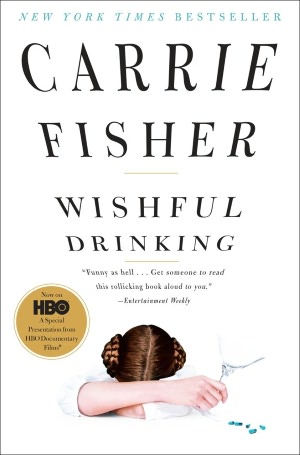
Review: Wishful Drinking - Carrie Fisher

My Mum and Dad were two thirds of the Brad, Jen and Angelina of the '50s.  I love them both despite their flaws.  I did Star Wars.  I married, then dated Paul Simon.  A lot of his (depressing) lyrics are about me.  I have a sense of humour, which is a really good thing.  I was addicted to a whole bunch of drugs and alcohol.  I wrote a novel about it, and my famously dysfunctional family.  A gay friend of mine once died in my bed which gave me PTSD.  My second husband left me for another man, which messed with me even more.  Through all this, I was bipolar, but didn't know it.  When I did, I received electroshock therapy, meaning I can't remember much.  I'm now under treatment and living a more centred, normal life than ever before.

This may as well be Carrie Fisher's book Wishful Drinking, a text adaptation of her successful one-woman stage show.  Really, without much exaggeration, the paragraph above could well represent the entire lightweight 150+ pages.  It's patently a cash-in from the stage show, which was was designed to be a humorous recollection of what led her from famous parents, through Star Wars to Simon, addiction and commitment to various asylums.  Unfortunately this sight-gag-reliant, disjointed and vague approach is acceptable (even desirable) in a spoken word performance, it falls flat as a text.

Image courtesy: barnesandnoble.com
The other reason for this eclectic authorship is a result of Fisher undergoing electroshock therapy for mental illness.  This means she simply doesn't remember much of her life, as the treatment rendered whole chunks of her past are a virtual nonevent.  Being unable to recall much of one's life has the capacity to make a memoir either oddly ethereal or painfully shallow.  Fortunately, Fisher stays mainly with the former and the book accurately represents what she remembers of her life - a series of unconnected events with their nascence stemming from a naive showbiz upbringing, early fame and drugs. 

She gets more serious - but not much, given her stated aim of finding humour in the blackness - when writing of her issues with mental health.  The book ends with a moving one-page tribute to those similarly afflicted, pleading for their everyday battle needs to be respected rather than shunned.  Fittingly and redeemingly, it is the most coherent and lucid page of the entire book.  The narrative style means Fisher's constant struggle with mental illness is danced around, but is the gravitas keeping the book from being not so much light as vaporous.

There is every chance my answer to the archetypal profile question "Who would you most like to have dinner with?" would include Carrie Fisher.  This would be for reasons of then and now.  (The second clip actually boasts many/most of the book's best gags.)  While the botox-free 1982 version would be welcome for re-living my childhood and teen years, the 2012 edition would provide a completely different perspective on almost every conversation.  As much as my teen self hates my 2012 version for writing it, this year's Carrie Fisher would take a seat at my table.  However, this still can't make me recommend her book too highly - marbles - it loses something in translation.  See the show instead.